The TL1A Gold Rush
Six pharma companies, one target, and a private equity firm walk into a clinic

Sometimes a single biological target captures the imagination (and the checkbooks) of an entire industry at once. TL1A is such a target.
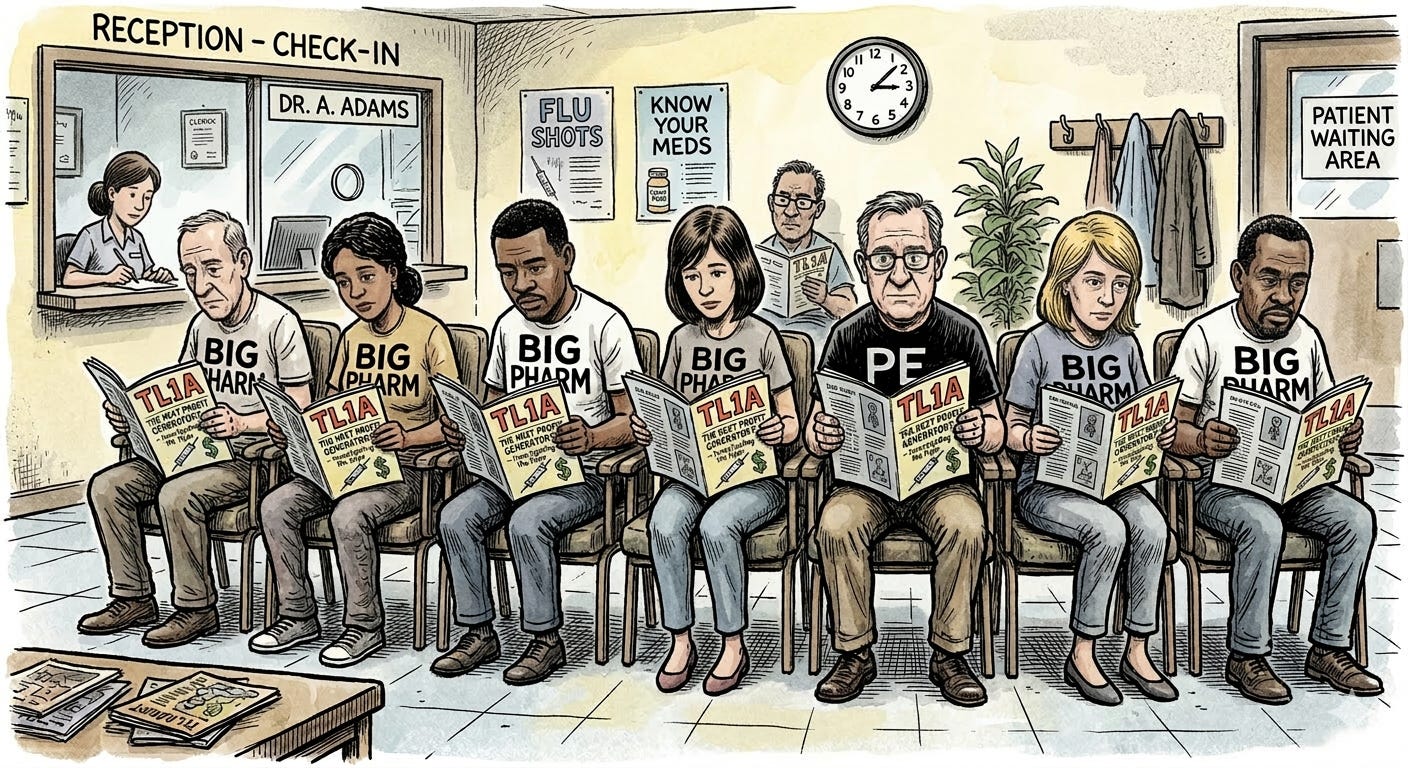
TL1A (tumor necrosis factor-like cytokine 1A, for those keeping score at home) is a protein that amplifies inflammation and drives fibrosis in the gut. Block it, and you might be able to treat inflammatory bowel disease (Crohn’s and ulcerative colitis) better than anything currently on the market. That hypothesis, which felt speculative as recently as 2022, has since attracted somewhere north of $30 billion in acquisition and licensing activity. And the money keeps showing up. Earlier this month, Blackstone Life Sciences committed $400 million over four years to bankroll Teva’s Phase 3 program for duvakitug, one of three TL1A antibodies now in pivotal trials. The question worth asking, as with any gold rush: is there actually that much gold?
Let me walk through what happened here, because the deal archaeology is genuinely fascinating.
The TL1A Party
The modern TL1A story starts with Prometheus Biosciences. Prometheus had a Phase 2 TL1A antibody called PRA-023 (now MK-7240, now tulisokibart, because pharma loves renaming things) and some impressive ulcerative colitis data showing 26% clinical remission versus 1% on placebo. Merck liked those numbers enough to buy Prometheus for $10.8 billion in June 2023. That alone would have been a notable deal. A $10.8 billion acquisition for a single Phase 2 asset in gastroenterology. The implied conviction is enormous.
The Prometheus auction was, by all accounts, ferociously competitive. AbbVie and Bristol Myers Squibb were reportedly in the mix. Merck announced the deal on a Sunday and, rumor has it, won the auction by way of an exploding offer that Prometheus couldn’t refuse. Scott Barshay at Paul Weiss represented Merck. If you follow life sciences M&A counsel the way some people follow sports coaches, you know that name.
But then October 2023 happened, and the TL1A feeding frenzy began.
Within weeks of each other, two more deals landed. Roche paid $7.1 billion to acquire Telavant, a joint venture between Roivant and Pfizer that held the rights to another TL1A antibody (RVT-3101, now afimkibart) in the U.S. and Japan. Separately, Sanofi paid Teva $500 million upfront (plus up to $1 billion in milestones) to co-develop and co-commercialize duvakitug, a third TL1A antibody that was further behind the leaders but showed a potentially differentiated binding profile.
So in the span of about four months, three Big Pharma companies spent a combined $18.5 billion (in upfronts and acquisition prices alone) to access three different antibodies all aimed at the same target. The Telavant deal had an interesting wrinkle: Pfizer had partnered with Roivant to form Telavant only eleven months earlier. Roivant essentially flipped its 75% stake to Roche for a quick multi-billion dollar return. Pfizer retained the ex-U.S./Japan rights and a 25% cut, but still. Eleven months. That’s a faster turnaround than most house flippers manage.
Then the field got more crowded. In June 2024, AbbVie licensed FG-M701 from China’s FutureGen Biopharmaceutical for $150 million upfront (plus up to $1.56 billion in milestones), adding a preclinical TL1A antibody positioned as a next-generation molecule with potentially differentiated potency and dosing. At $150 million upfront for a preclinical asset, the deal reads as a relatively inexpensive option on a validated target. AbbVie has deep commercial infrastructure in IBD through Humira and Skyrizi, but the molecule is way behind the Phase 3 leaders.
And early this year, in January 2026, Boehringer Ingelheim licensed SIM0709 from Shanghai-based Simcere in a deal worth up to €1.05 billion. The BI deal, however, is different (and for a reason that regular readers of this newsletter will recognize as a familiar theme): SIM0709 is a bispecific antibody that targets both TL1A and IL-23p19, two distinct inflammatory pathways, simultaneously. IL-23 inhibitors already have blockbuster drugs on the market for IBD (J&J’s Tremfya, AbbVie’s Skyrizi, Lilly’s Omvoh). So BI is making a bet that the future of TL1A might actually be TL1A-plus-something-else. A €42 million upfront payment to find out seems relatively cheap compared to what Merck and Roche paid for their standalone programs.
BI isn’t the only one thinking along these lines. Several players are increasingly focused on TL1A as a combination play. Is the combo thesis driven by early signals that TL1A monotherapy has an efficacy ceiling? No. TL1A as a mono is quite compelling. It’s a competitive calculus: if Merck and Roche will own the TL1A mono space with Sanofi a year or two behind, the best way to differentiate is to combine TL1A with a proven mechanism and try to leapfrog the mono entirely. Simcere’s preclinical data for SIM0709 actually benchmarked the bispecific against guselkumab (J&J’s Tremfya) on the IL-23 arm and showed superior dual pathway blockade. The commercial positioning is obvious: why prescribe two drugs when one bispecific could do both?
Notice, by the way, that both the AbbVie and BI deals sourced their molecules from Chinese biotechs (FutureGen and Simcere, respectively). The China-to-West licensing pipeline, which we’ve explored in this newsletter’s “Going East” series, keeps showing up in new therapeutic categories.
The PE-ization of Pharma
Now let’s talk about the deal I find most structurally interesting.
On March 3, Teva announced that Blackstone Life Sciences would provide $400 million over four years to support duvakitug’s Phase 3 development. In exchange, Blackstone gets regulatory and commercial milestones (amounts undisclosed) and low single-digit royalties on worldwide sales.

Think about this deal from Teva’s perspective for a moment. Teva already has a partner in Sanofi. The 2023 collaboration gave Sanofi co-development and co-commercialization rights. The two companies split development costs equally and share profits in major markets. Sanofi leads the Phase 3 program. So Teva was already getting significant financial and operational help. Why bring in another party?
Because Phase 3 development for a program this size is breathtakingly expensive. The duvakitug program will enroll over 3,000 patients across UC and Crohn’s disease, with follow-up periods lasting 40 weeks or more. Teva’s total R&D spending topped $1 billion in 2025. For a company in the middle of a strategic reinvention it calls “Pivot to Growth” (a bit of corporate poetry that tells you everything you need to know about where they’ve been), the capital discipline matters. Blackstone’s $400 million buys Teva balance sheet flexibility without diluting its equity or restructuring the Sanofi collaboration.
From Blackstone’s perspective, the math is different but equally interesting. Blackstone Life Sciences has built an entire franchise around what you might call “renting clinical risk.” They funded $750 million of Moderna’s flu vaccine program. They put $700 million into Merck’s TROP2 ADC program (sac-TMT). They’ve done similar deals with Alnylam, Sanofi, and Autolus. RBC Capital Markets noted that BXLS has over $10 billion in assets under management and claims an 85% Phase 3 success rate, compared to the industry average of 48%.
The model works like this: Blackstone pays development costs today. If the drug gets approved, they earn milestones and royalties. If it fails, Blackstone eats the loss. The pharma company retains all decision-making authority and control over development, manufacturing, and commercialization. Blackstone gets no rights to the drug itself, no board seat, no governance role. They just get paid if the drug works.
If that sounds a lot like a very expensive, very sophisticated bet, that’s because it is. But it’s a bet with a strategic advantage. In practice, Blackstone has consistently committed capital to programs that already have Phase 2 data in hand. They’re not taking discovery-stage risk. They’re not even taking Phase 1 risk. They’re buying into the narrowest, most de-risked slice of clinical development, where the science is substantially validated but the bills are enormous. Private equity, traditionally allergic to the binary outcomes of drug development, has figured out how to time its entry to capture the moment when risk is falling but the capital need is peaking.
One commentator called this the “PE-ization of pharma.” That feels right. And for anyone who structures collaborations for a living (hello), the layering here is genuinely novel. Duvakitug now has three distinct financial stakeholders: Teva (originator), Sanofi (co-development and co-commercialization partner), and Blackstone (development capital provider with royalty participation). Each took a different slice of risk. Each expects a different return profile. The royalty stack alone would be fascinating to model out: Sanofi’s profit share in major markets, Blackstone’s low single-digit royalties on worldwide sales, and whatever Teva nets after paying both. If duvakitug works, everyone gets fed. If the market fragments across four or five approved TL1A antibodies, the economics get a lot tighter.
Which brings us to the question I keep coming back to. There are now three TL1A antibodies in Phase 3 (tulisokibart, afimkibart, duvakitug), at least two more in Phase 2 (including Spyre Therapeutics’ extended half-life programs), AbbVie’s preclinical asset, and BI’s bispecific. Merck has expanded tulisokibart development into hidradenitis suppurativa, ankylosing spondylitis, and rheumatoid arthritis, which tells you something about the conviction that TL1A’s therapeutic reach extends well beyond IBD.
The IBD market is enormous (over three million patients worldwide, many of whom cycle through multiple therapies without achieving durable remission). But “enormous market” and “room for six competitors” are different propositions. The existing standard of care already includes TNF inhibitors, IL-23 inhibitors, integrin inhibitors, and JAK inhibitors. TL1A drugs won’t be entering a vacuum. They’ll be competing with each other and with deeply entrenched incumbents.
The anti-fibrotic angle is the wild card that keeps the bulls excited. Current IBD therapies are primarily anti-inflammatory. TL1A inhibitors may also address fibrosis, the scarring that drives disease progression, particularly in Crohn’s. If clinical trials confirm meaningful anti-fibrotic effects, TL1A drugs could rewrite the treatment paradigm rather than just adding another option to an already crowded menu. Merck has been developing a companion diagnostic (a genetic-based test identifying patients most likely to respond to tulisokibart) that could further sharpen the value proposition. Precision medicine in IBD would be genuinely new.
Thirty billion dollars is a lot of conviction. And I think some of that capital is going to get incinerated. Not because TL1A is wrong as a target (the Phase 2 data is real), but because six-deep into a competitive field, “me too” molecules don’t survive. The companies that win will be the ones that can meaningfully differentiate: a bispecific that outperforms mono, a companion diagnostic that identifies responders, a dosing schedule that changes the compliance math, a first-mover advantage that locks up prescribers before the rest of the field arrives. Everyone else is buying a very expensive lottery ticket.
Phase 3 data from the leaders should start arriving later this year. That’s when we’ll find out how many of these bets were prescient and how many were just expensive.